Testing link to a recording of piano music (Jessica's theme, from the movie The Man From Snowy River).
Saturday, December 15, 2012

Studies in digestion
I beautifully procrastinated on my biostats homework yesterday by learning about the Rule of 20. This is the mnemonic for all the many many thingies* to check on patients in critical care. My favorite by far is nutrition, because it is so important and yet easy to overlook. It requires thinking of the digestive tract as a true ecosystem all of its own. Vet school was the first place I had come across this notion, in such a way that it made sense** and it recasts the world when you start thinking of your intestines as something not unlike Pike Place Market. Fewer fish flying through the air, y'know, but otherwise, just like. It's not just the easily angered proletarian masses of bacteria, either. There's the constantly sloughing, constantly regrowing cells that balance the tract and absorb nutrients and respond to the environment. If they don't get fed, they are subject to atrophy, microscopic ennui robbing them of purpose.
So feeding the patients is important and feeding the patients in a normal way, i.e. the food goes into their stomach, then moves on to their intestines in due course. The odd nasogastric tube or surgically placed stomach tube takes nothing away from this process, but parenteral nutrition (enteral being the normal way), in which we inject a nice amino acid slurry through the IV catheter, misses the point of keeping ALL the patient's systems healthy. It is sometimes necessary, but it means that the instant that patient can hold down anything--usually the most pureed chicken-flavored baby food that money can buy--someone gets to start feeding him globs of it on a tongue depressor.
But today is back to biostats. I am indulging in a good breakfast, a la the importance of digestion, inspired by my conversation with myself:
--"I want french toast."
--"We always have french toast."
--"What spices can I use that I haven't put in french toast before?"
--"Um...we've used cinnamon, nutmeg, allspice, ginger, thyme, basil, pepper, cloves, and rosemary..."
--"Oo, I found rose extract!"
--"..."
--"Surely that would work?"
--"To the internets!"
And I found a lovely rose-cardamom french toast recipe here.
*technical term
**Apparently for things to make sense I need to spend about twenty hours staring through a microscope at intestinal biopsies.
Tuesday, December 11, 2012
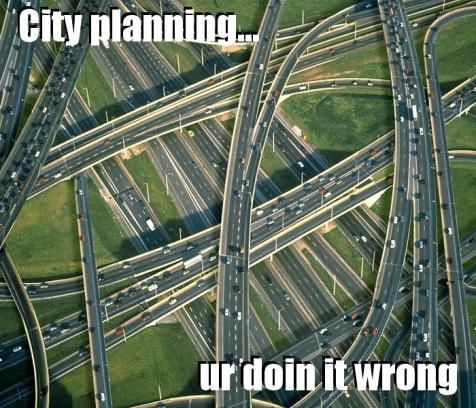
Social Trust, Spaghetti Junctions
Apropos of my class in risk communication, which is starting to wind down, I came across this article ( Atlanta Journal-Constitution article on Atlanta's Metro ) about Atlanta's problem getting their metro system fixed up.
 The gist of the story is that everyone in Atlanta knows the city's metro system needs to be updated in a major way, and astoundingly, everyone is willing to pay for it (more or less...about 2/3 said they would put money down). So far so good, right? Even the suburbanites have started asking when they're going to get rail, which goes to show how awful the commute has gotten.
But when the referendum to put $7.2 billion into roads and metro was up for voting this summer, it was turned down.
How?
Because the people of Atlanta, according to the poll described in the AJC story, don't trust their public officials not to screw it up.
The determinants of trust, for corporations and government agencies, are pretty basic.
Hopefully the poll will help them figure out what they have to do to prove they can responsibly handle billions of dollars. It might take a while. Especially with all the traffic.
I like Atlanta, but I have to agree, its transportation system is a mess.


But when the referendum to put $7.2 billion into roads and metro was up for voting this summer, it was turned down.
How?
Because the people of Atlanta, according to the poll described in the AJC story, don't trust their public officials not to screw it up.
The determinants of trust, for corporations and government agencies, are pretty basic.
- 1. Competence, expertise
- Yep, that one's been screwed up by highway construction that didn't finish on time, by decisions to put trains in politically convenient locations, and general inability to fix the existing transport problems.
- 2. Commitment to the public good
- Also damaged, mostly by political scandals and corruption cases
- 3. Concern, care
- Political shenanigans don't help with this one either. Transparency can go a long way here, and probably got damaged during previous roadwork projects where toll roads popped up without warning, that sort of thing.
Hopefully the poll will help them figure out what they have to do to prove they can responsibly handle billions of dollars. It might take a while. Especially with all the traffic.
I like Atlanta, but I have to agree, its transportation system is a mess.
Friday, November 30, 2012
Grad School vs Vet School
As a veterinary student, it was a given that time was not only a valuable commodity, but it would be spent on SLEEP, the sooner the better. And maybe studying, and perhaps two hours a week could be diverted into the most basic of life maintenance, such as eating dinner with family members, significant other, or the one non-vet-school friend who still found your stories about animal anatomical oddities entertaining (it's important to hold onto friends like that).
Then there is grad school. Grad school does not cling quite so tenaciously to your life as vet school.
Vet school latches on the second day of orientation and for the next four years reminds you constantly that you are going to be a Doctor, with Responsibilities, to say nothing of Board Exams. Also you have two patients to write discharge instructions for and rounds starts in an hour and you haven't looked up ketoacidosis in small ruminants yet.
Also you need to do treatments, like, now.
Grad school, on the other hand, stretches luxuriously in the morning, looks at the clock, and says, "Eh, I don't have any classes or work on Wednesday, I'll sleep in a little and be better rested to work on my essays." (Obviously people who have jobs to juggle with classes are going to be in more of a vet school category of time management.)
Nor does grad school place the same emphasis on facts...facts are secondary to the bigger picture of synthesizing ideas, making connections, and revising your resume to a finely honed reflection of your finest career attributes.
The veterinary student side of me freaks out about this.
The grad student side goes, "I will think about things...hm, what should I make for dinner?" Once in a while the grad student side also goes, "Holy cow, I have a lot of homework to catch up on." However, there are always a few more hours in the day, we're mostly just skimming articles anyway, and it's important to take time...to synthesize.
And then you get to that point in the semester where all the essays come due, the one class that involves knowing facts has an exam and it occurs to you that with all the synthesis and all the leisurely discussions, you still don't know what your job would actually entail. And then grad school is just like vet school but with even less certainty of what you do when you graduate, except that you aren't done for the day when you leave the school because there's always more essays to write and readings to synthesize.
And it's a lot harder to write discharge instructions in AMA style.
Monday, November 19, 2012
The internship hunting process
I cannot help but reflect that, had I known six months ago that my back-up plan for public health was going to be getting some more clinical experience by way of an internship, I would have been a little more careful to talk to some interns in the many interesting places I was visiting. Everything was public health-themed, however, and there are enough alternate paths in that field alone to keep a student busy figuring out all the options.
EDIT: My unexpected favorite question to ask: What are you looking for in a candidate? I liked this question because it let me see what the clinic was looking for and whether that fit with what I can expect to offer as an intern. It sometimes sparked really long tangential conversations. It's only moderately awkward to ask, it helps to remember that you are interviewing them almost more than they are interviewing you.
I also would have contacted some of my clinicians from school earlier and made sure that they could recognize me from the crowd. And that they covered a range of specialties (tip: selection committees are made up of clinicians...and they expect to see clinician letters of recommendation. Epidemiologists, even epidemiologists with a medical degree, do not quite count).
There has been scrambling, added to the scrambling for school and mid-term essays, and the scrambling on the other end of the intern hunting process, which is going and looking at the clinics I'm applying to. I was disappointed in the internet's paucity of advice on this topic. Questions that occurred to me:
1. What do you wear if you are visiting a clinic for a day? Nice scrubs? A suit that can survive the odd encounter with a patient? I suspect most clinics don't intend to let unvetted (pardon the pun) intern applicants touch the animals, much less treat them. But...you never know. There are clinics that do, assuming that if you are put together enough to be visiting for internships, you must have reached a basic level of competence in fourth year.
EDIT: A suit. Everyone I saw was dressed as for an interview. I was dressed as for an interview and fit right in. Have a suit that you can stand to get pet-hair on because the chances are good you will end up restraining an enthusiastic golden retriever puppy for a student or a tech or a clinician.
EDIT: A suit. Everyone I saw was dressed as for an interview. I was dressed as for an interview and fit right in. Have a suit that you can stand to get pet-hair on because the chances are good you will end up restraining an enthusiastic golden retriever puppy for a student or a tech or a clinician.
2. How much time can you expect to spend? What is a good amount of time? On the one hand, I can see how tripping in, looking around, and tripping back out again isn't going to make a good impression. But how long do you stay if you've gotten a feel for the place and are on a tight schedule for the next visit? Do you plan on staying a whole shift? In some clinics that's a five hour day, if they're not busy. In others it is 14 hours and counting. And if it is the latter...at which point do you politely begin to edge to the door?
EDIT: Five hours seemed the average. You've started to get tapped out on the question front, the clinicians are still working and have asked you all the questions they're going to. If you have the whole day and are really excited about seeing some procedures go ahead and ask to borrow some scrubs, but otherwise say thank you and head out.
EDIT: Five hours seemed the average. You've started to get tapped out on the question front, the clinicians are still working and have asked you all the questions they're going to. If you have the whole day and are really excited about seeing some procedures go ahead and ask to borrow some scrubs, but otherwise say thank you and head out.
3. How exactly does one go about cornering the current interns to ask them if they are the happy sort of zombie-med-students or the unhappy sort? One clinic I was at had happy zombies, but with that special desperation of doctors who have one day a month to sleep.
EDIT: Around hours 3-4 the clinicians lose interest in you and you can shadow the interns. I got a much better sense of the intern culture at one clinic by stopping in at their closet-sized "lounge" while they were taking a Christmas-cookie break. The intern space says a lot too--this one was clearly used and kept up from year to year.
I'm sure more questions will occur presently, but I'm starting to feel a bit zombieish myself.
EDIT: My unexpected favorite question to ask: What are you looking for in a candidate? I liked this question because it let me see what the clinic was looking for and whether that fit with what I can expect to offer as an intern. It sometimes sparked really long tangential conversations. It's only moderately awkward to ask, it helps to remember that you are interviewing them almost more than they are interviewing you.
Sunday, November 18, 2012
What to do if...
...you dump a quarter cup of cinnamon into a half a cup of applesauce?
I opened the wrong side of the shaker top.
Maybe mixing it into cookies?
I opened the wrong side of the shaker top.
Maybe mixing it into cookies?
Wednesday, November 7, 2012
Letters, explained in 7 steps
I sense I am entering a letter-writing phase.
This is brought on by newly acquired stamps (they've got pretty pictures!) and the most recent card from a friend in immaculate handwriting that, try as I may, I will never come close to replicating. Also, I haven't sent mail in weeks. I'm not very conscientious about it--if I got really desperate, I could always write to family, of all people--but I start getting twitchy when I realize I haven't used up any stationery in the last month (it means I'm not allowed to buy more. It's like yarn, that way--you know you're really not supposed to by another three skeins until you've finished that afghan, but they're so pretty...).
Of course, it's hard to write letters into a void. The occasional word of encouragement works wonders. One friend I write to on a semi-annual basis has a reply rate of once a year, so we're even. It just has to translate as, "Yes please keep writing me letters", and not, "oh by the way I got another letter from you and feel compelled to let you know, but you Really Should Not Bother." I don't think I've encountered the latter
In classic go-to preparation, I googled "letter writing" to see what comes up. And---gosh, how-to websites seem to have cornered the market on this. Their average article goes like this:
Step 1: Dear ____
Step 2*: How are you? How is the weather? How is the family? How is the potted plant? How is the planning of ultimate doom coming along? (pick 2-3)
Step 3: I'm fine. The weather is sleeting. The family is blooming. The potted plant is coping. It is proceeding as I have foreseen.
Step 4: An interesting thing happened to me today. [Insert interesting thing]**
Step 5: Oh golly would you look at the time?
Step 6: Please write. Or don't. I only put it in because ehow.com said I should.
Step 7: Find a more interesting link and follow away from the topic of letter writing. Your friends and family are safe for another week.
*Step 2 may be moved to follow step 4.
**When one of these letters is written by a medical professional, step 4 can get really weird--assuming you are able to wade through the acronyms. Having received one or two case studies-disguised-as-letters, I speak from experience.
Part II, (work in progress):
Not to knock the wikihows, I was hoping for something a little more substantive. Like examples of awesome letters written by famous writers. I found one reference to a book of Saul Bellow's letters. Aside from the enlightening influence of wikipedia, I have not idea who Saul Bellow was, except he evidently was a very highly esteemed writer who also wrote lots of letters, helpfully collected into a book. I read one of the excerpts. It was promising, entertaining and evocative, almost enough to convince me I should read one of his books before I read his letters.
Then I followed the wikipedia link to one of his books.
Oh, he's one of those writers.
I'm finding that the famous authors who receive all sorts of literary acclaim are less fun to read. I'm biased toward SciFi/Fantasy anyway, but I feel about famous works of literature the way I feel about most abstract art: vaguely annoyed that I have to read up on three hundred years of literary theory to know what the point was. Also, it seems to be a trope that if it wasn't deep enough, toss in disturbing treatment of children. Someday I maybe will get really into high literature and eat my words, but at the moment, I have seen this trend:
I like famous authors talking about the real world.
I do not like their books.
This so far has held true for Hemingway, Steinbeck, and Kurt Vonnegut, plus a few others who do not come to mind right now. Something about really good writers who then go and write groundbreaking treatises on the human condition fails to hold my attention, but I do love reading their missives.
Subscribe to:
Posts (Atom)